The 423 Recovery Model
How 423 Works
A biblically grounded, clinically informed, community-based model for long-term recovery.
423 helps men, women, young people, spouses, families, and churches find hope, healing, and restoration from problematic sexual behavior, addiction, shame, and betrayal trauma through biblically grounded, clinically informed, confessional recovery communities.
Rooted in the Gospel
We believe recovery is discipleship.
Powered by Community
We heal in relationship, not isolation.
Informed by Clinical Wisdom
We use proven tools to bring awareness and build lasting change.
Recovery Is Discipleship
Learning to Live in the New Life We Have Been Given in Christ
At 423, recovery is not a separate category from spiritual formation. It is the process of learning, through the Holy Spirit and the body of Christ, to bring the hidden and wounded places of our lives into alignment with the new identity we have already received in Jesus.

“If anyone is in Christ, he is a new creation. The old has passed away; behold, the new has come.”
2 Corinthians 5:17The theological center of the model
We are not trying to create a new identity. We are learning to live from the one Christ has already given.
Sexual brokenness is not merely a behavior problem. It touches the heart, the body, the mind, the story, the nervous system, and our relationships with God and others. Scripture tells us that we have been made new in Christ, yet it also names the honest wrestling that remains: disordered desire, the flesh, shame, secrecy, and a body still trained by old patterns.
Recovery, then, is discipleship at the level of the whole person. It is learning to walk in the light, confess sin without collapsing into shame, identify where the heart has turned aside, and practice a new way of life in the safety and truth of biblical community.
The goal is not simply sobriety from unwanted sexual behavior. The goal is restored intimacy with God and others — a life increasingly aligned with the abundant life made available in Christ.
New Identity
Members are grounded in who they are in Christ before they are asked to change what they do.
Honest Wrestling
We name the reality of the flesh, shame, broken desire, and old patterns without losing sight of grace.
Biblical Community
Recovery happens as members are witnessed, known, challenged, and loved inside the body of Christ.
Integrated Awareness
Clinical tools help members see where pain, attachment wounds, triggers, and false comforts have shaped the heart.
The 423 conviction
Scripture gives the story. Christ gives the identity. The Spirit gives the power. The body of Christ gives the healing environment.
Clinical recovery tools do not replace the gospel. They help us bring awareness and language to the places where the heart has turned aside, where core desires have been broken or twisted, and where the body has learned to medicate the pain of sin through compulsive patterns.
In 423, those places are brought into the light through confession, community, story work, spiritual practices, nervous system repair, and long-term discipleship.
The Theological Frame
New Life in Christ, Honest Wrestling, and the Long Road of Sanctification
423 begins with a biblical vision of the whole person. We are image-bearers created for communion with God and others, redeemed in Christ, indwelt by the Spirit, and called to walk in the light. Yet we also continue to wrestle with broken desire, embodied habits, shame, secrecy, and patterns formed by sin and suffering.
Recovery is the Spirit-led process of learning to live from the new identity we have been given in Christ, while bringing every hidden and disordered place into the healing light of God and biblical community.
We have been given a new identity.
The believer is not trying to earn a new name through recovery. In Christ, the old self has been crucified, shame no longer has the final word, and the people of God are invited to walk as sons and daughters who belong to Him.
- Forgiven and reconciled to God
- Given the Holy Spirit
- Made part of the body of Christ
- Invited to walk in the light
We still wrestle with a broken system.
Scripture is honest about the ongoing battle with the flesh: desires that become disordered, bodies trained by old patterns, minds shaped by shame, and hearts that turn aside toward false refuges when pain feels overwhelming.
- Disordered desire and false comfort
- Embodied habits and compulsive patterns
- Shame, secrecy, and self-protection
- Attachment wounds and distorted identity
“The old has passed away; behold, the new has come.”
2 Corinthians 5:17“Confess your sins to one another and pray for one another, that you may be healed.”
James 5:16“Walk by the Spirit, and you will not gratify the desires of the flesh.”
Galatians 5:16The movement of recovery
From hiding in shame to walking in the light.
423 helps members bring the full reality of their lives before God and trusted community. Not only the behavior, but also the fear, the wound, the craving, the body response, the story, the desire, and the false attachment that has formed beneath the surface.
Notice
Members learn to see the patterns, cues, emotions, triggers, and internal beliefs that usually remain hidden.
Confess
Members practice bringing sin, shame, desire, fear, and pain into the light with God and trusted witnesses.
Receive
The body of Christ becomes a place where truth and grace are experienced together, disrupting isolation and shame.
Practice
Members build new patterns of prayer, regulation, honesty, connection, repair, and Spirit-led obedience over time.
The Problem Is Not Just What Someone Is Doing. It Is What They Have Learned to Run To.
Sexual addiction is sin. But it is also often a learned escape from pain. What looks like a choice on the surface is usually a solution underneath—one that once made sense in a moment of hurt, fear, or loneliness.
Over time, the brain and heart attach to counterfeit relief. What begins as coping becomes a pattern. And what once promised comfort ultimately creates bondage.
Lasting freedom comes not only by stopping the behavior, but by healing the deeper places—the broken core desires, twisted attachments, false comfort, and shame that keep the cycle alive.
Broken Core
Desires
Twisted
Attachments
False
Comfort
Shame &
Secrecy
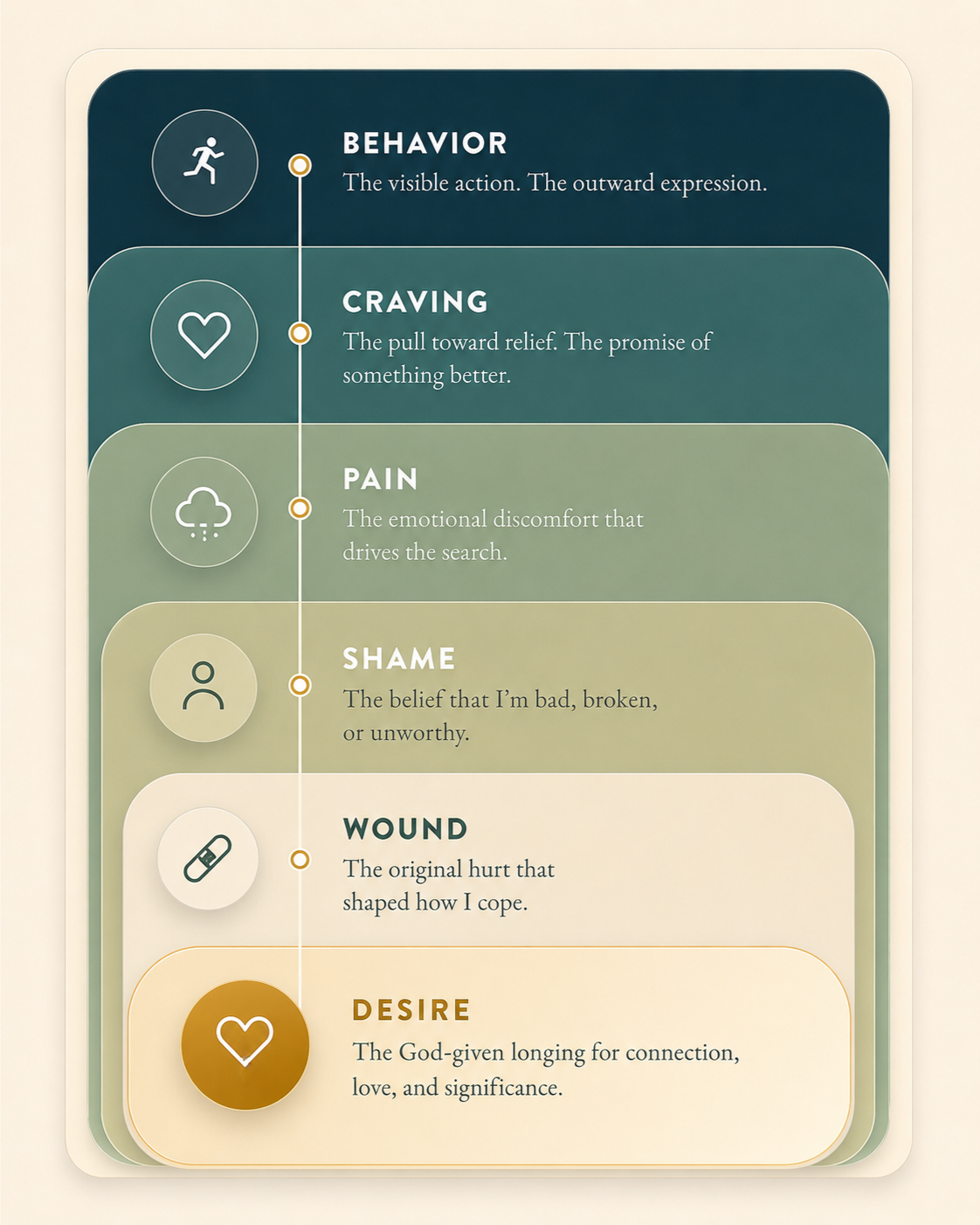
What we see on the surface—behavior—is rarely the real problem. It is often a solution to something deeper. Freedom comes as we move beneath the surface and address what the heart has been running from.
Two Interwoven Cycles: Addiction and Compulsion
Behavioral addiction and deeper compulsion are interwoven but not the same. One is driven by neurochemistry and habit. The other is driven by wounds, unmet longings, and the search for identity and relief.
Healing requires addressing both. When we break the cycles at the root and retrain the heart and brain together, freedom becomes not just possible—but lasting.
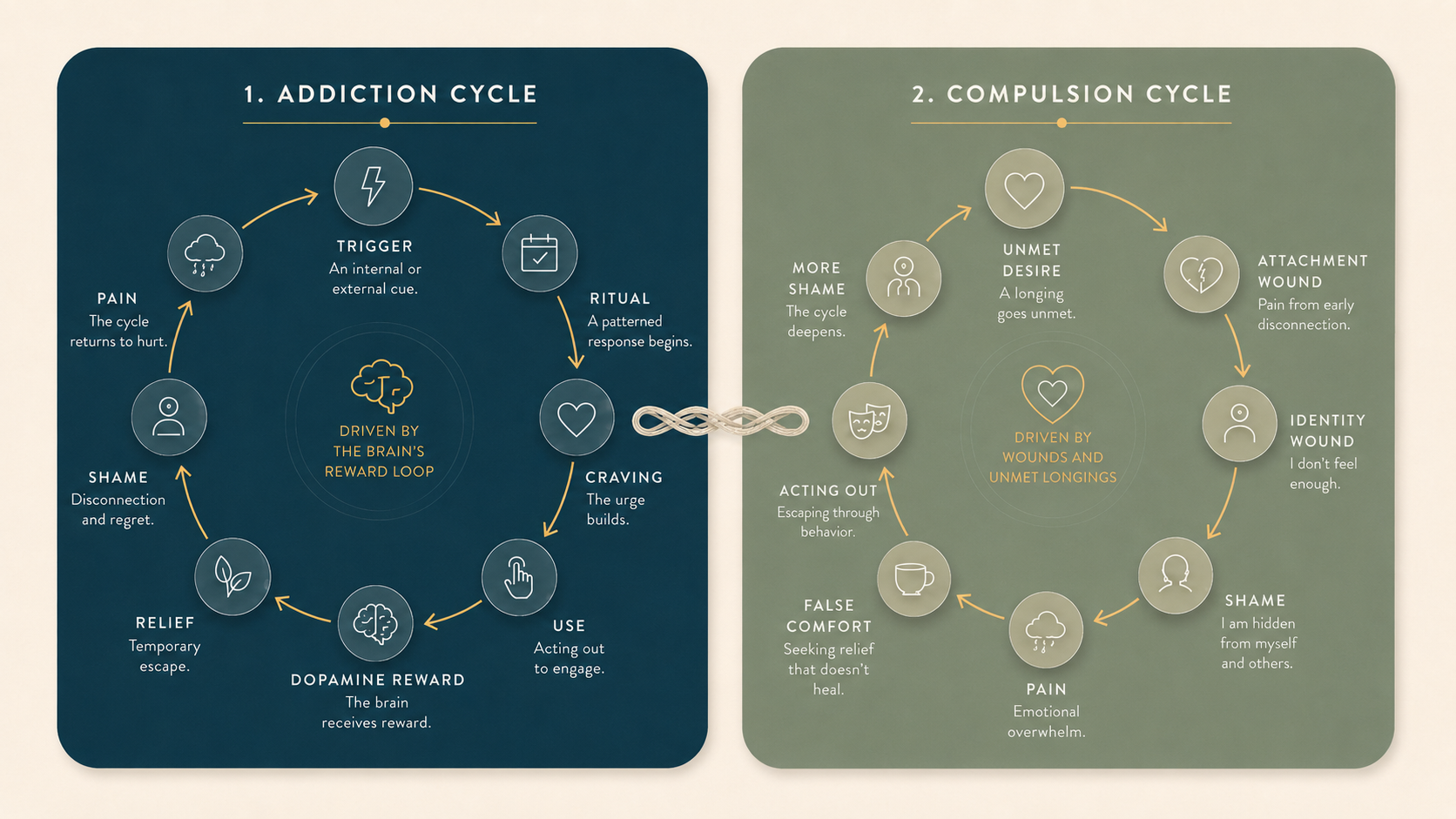
Addiction trains the brain to seek relief. Compulsion reveals the deeper wounds and desires beneath the behavior.
The Integrated 423 Model
Four Streams of 423 Discipleship
The cycles of addiction and compulsion do not heal through behavior management alone. Freedom requires a pathway that addresses the mind, body, heart, story, habits, worship, and relationships together.
The 423 model integrates clinically informed recovery with biblical formation, helping men move toward healing without separating truth from compassion, or theology from embodied care.
Theological Formation
We begin with who God is and what he says is true. Shame tells a man he is uniquely ruined; the gospel tells him he is seen, pursued, convicted, cleansed, and invited into a new way of life in Christ.
Interpersonal Neurobiology
Addiction forms in the brain and body, often around isolation, stress, fear, and unmet attachment needs. Through attuned community, confession, co-regulation, and new relational experiences, the brain begins to learn safety again.
Clinical Healing Paired with Doxology
Heart · Brain · Body · Community · Worship
Clinical Recovery Tools
Men need practical tools for naming triggers, understanding the addiction cycle, building relapse prevention, engaging story work, repairing relationships, and learning how to respond to pain without returning to false comfort.
Biblical Community and Spiritual Practices
Recovery is not meant to happen in hiding. The body of Christ becomes a place where confession, prayer, Scripture, testimony, encouragement, repentance, and love reshape the stories men have carried alone.
423 is not simply helping men stop a behavior. We are helping them become whole disciples whose desires, stories, bodies, relationships, and worship are being reordered toward life in Christ.
The Witnessing Community
Where Shame Is Disrupted and Transformation Takes Root
Shame grows in secrecy. It teaches a man to hide, perform, minimize, and carry his story alone. A witnessing community interrupts that isolation by creating a place where he can be seen in truth and still met with grace.
In 423, being witnessed is not passive observation. It is the practice of surrounding one another, seeing clearly, speaking truthfully, bearing burdens, confessing sin, praying together, and calling one another forward toward Christ.
Healing takes root where hidden stories meet embodied grace.
Seen · Known · Loved · Called Forward“Since we are surrounded by so great a cloud of witnesses, let us lay aside every weight and sin… and run with endurance the race set before us.”
The picture is not isolated striving, but a surrounded life. Witnesses are those who see, testify, encourage, and speak truth. The community helps name the weight and sin that entangle, while strengthening one another to keep running.
Hebrews 12:1 Gives Us the Shape of a Witnessing Community
The picture is active and enclosing: a community encircling the runner, not merely watching from a distance. The wounded disciple is not left alone to fight shame in isolation.
A witness sees and speaks. This is the heart of the model: men are seen truthfully, spoken to graciously, and reminded of what is true when shame has distorted their story.
The race is hindered not only by obvious sin, but by burdens, shame, fear, secrecy, and the stories that make holiness feel impossible.
Sin clings, surrounds, and ensnares. The community helps men name the vines around their lives and begin walking in repentance, endurance, and freedom.
Being Seen
Men bring what has been hidden into a safe, attuned space. Naming sin, pain, desire, and fear begins to loosen the grip of secrecy.
Being Met
When stories of shame are met with compassion and truth, the nervous system experiences safety, and old relational messages begin to be challenged.
Being Called Forward
Grace does not excuse bondage. The community helps each man practice repentance, repair, confession, sobriety, and a new way of life.
Safe
Safety is not the absence of truth; it is the relational soil that allows truth to be received without collapse, hiding, or self-protection.
Grace-Based
Grace allows men to tell the truth without pretending. They are not loved because they are clean; they are loved as Christ leads them into cleansing.
Truth-Telling
Witnessing includes honest naming: sin, wounds, patterns, impact, desire, and responsibility. The goal is not exposure, but healing in the light.
Christ-Centered
The community does not become the savior. It becomes a living witness to the Savior, helping men turn toward Christ together.
In a witnessing community, clinical tools and theological care work together: men learn to regulate, confess, grieve, repent, repair, and receive love in the place shame told them they could never be known — the body of Christ.
First Hour: Witnessing, Confession, and Recovery Line Reflection
Each week, men honestly reflect on their patterns, confess where they have struggled, and begin exploring what is happening underneath the surface.
Weekly sharing helps men reflect on patterns, triggers, and emotional responses.
By naming what happened during the week, men begin to see how choices, environments, and emotions connect and reinforce.
The goal is not only to name behaviors, but to notice what is driving them.
We look beyond the surface to understand the thoughts, emotions, wounds, and longings that influence what we do when no one is watching.
Confession, honesty, and insight from community help men move toward self-awareness and transformation.
In a safe and grace-filled space, men learn they are not alone—and that change is possible with God’s help, their own courage, and the support of others.
We ask:
What can we do to end the addiction? Heal the story?
The Recovery Line
A weekly reflection tool that helps men name behavior, identify warning signs, and move toward life-giving rhythms.
Above the Line
Healthy Behaviors / Spiritual Practices / Life-Giving Rhythms
Slippery Slope
Warning Signs / Red Flags
Below the Line
Unhealthy / Addictive Behaviors
Story Work: Discovering What Is Beneath the Surface
It is the privelage of every group member to be a witnesing community member, helping individuals process through their story in a safe and attuned community.
Engagement
Creating a safe, supportive space where a person feels heard through attunement and active listening.
Exploration
Thoughtful questions help uncover past experiences, relationships, and challenges that may be shaping current behavior.
Extraction
Patterns, emotional themes, and recurring struggles begin to emerge and can be named.
Reflection
Gentle feedback helps the person hear their story more clearly and grow in self-awareness.
Integration
What is learned is applied to identity, choices, and future growth—leading to deeper healing and lasting change.
Second Hour: Equipping, Tools, Curriculum, and Practice
The second hour moves from reflection into formation. It is where men receive a discipleship pathway for recovery — not just information, but practices that help them walk out healing with structure, clarity, and support.
From insight to embodied practice.
Recovery requires more than naming what happened. Men need a way to practice truth, engage their story, repair relationships, and build new rhythms of life.
Learn
Receive clear teaching around addiction, attachment, shame, confession, and the renewing work of Christ.
Practice
Use guided exercises, workbooks, spiritual disciplines, and recovery tools to engage the work personally.
Process
Bring what is discovered back into community where it can be witnessed, clarified, and gently challenged.
Integrate
Apply what is learned to daily life, relationships, relapse prevention, disclosure, and ongoing discipleship.
423 groups are not only support groups. They are environments of practiced formation.
In the second hour, the group engages tools that help men move beyond behavior management and into a deeper process of recovery and discipleship. This may include recovery workbooks, life-history mapping, disclosure preparation, relapse prevention, emotional awareness practices, spiritual disciplines, webinars, and clinically informed exercises.
423 utilizes dozens of in-house resources alongside trusted, world-class curriculum and clinical recovery frameworks. These resources are not treated as standalone information, but as practices that are brought into community, processed in relationship, and integrated into daily life.
A Curated Library of Biblically Informed, Clinically practiced resources.
The second hour gives men shared language, practical exercises, and weekly structure so the work of recovery does not stay abstract. What is learned becomes something practiced, processed, and lived.
Biblically grounded
The work is rooted in confession, repentance, grace, discipleship, and the renewing of the heart, mind, and body before God.
Clinically informed
Recovery practices draw from addiction recovery, trauma care, attachment theory, interpersonal neurobiology, and relational repair.
Community practiced
Men do not simply consume content alone. They bring the work back into a witnessing community where healing can be practiced in relationship.
Recovering holy desire beneath distorted desire.
423 helps members recover the truth that desire itself is not the enemy. Desire is part of what it means to be human. We were made to desire God, beauty, goodness, connection, intimacy, love, purpose, and restoration.
DesireSin does not create desire; it distorts it. Shame does not heal desire; it buries it. Addiction does not satisfy desire; it hijacks it.
Desire redeemed, reordered, and reattachedOne of the central questions in 423 is not only, “What did you do?” but “Why did this make sense to your system?” Fear-based recovery often asks, “How do I not act out? How do I not relapse? How do I not get caught? How do I not become that person again?” Those questions are not wrong, but they are incomplete. A person cannot build a whole life from “don’t.”
Finding Your Why helps members move beyond behavioral management into deeper restoration. The goal is not merely to stop a pattern, but to understand the wounds, stories, needs, and longings that made the pattern feel necessary. Beneath distorted behavior, there is often a good desire that has been broken by sin, shame, trauma, neglect, abandonment, relational pain, or the absence of repair.
Many members are carrying old narratives from moments when their attachment systems learned that the world was not safe, that they were too much, that others could not be trusted, or that their needs would not be met. These wounds may come from explicit abuse, but they may also come through neglect, abandonment, harsh words, emotional distance, secrecy, ridicule, exposure, or pain that was never named and never repaired.
These memories do not always stay in the past. They often become pathways. They shape how a person seeks comfort, connection, control, escape, power, or rest. When sexuality becomes interlaced with these wounds, pornography, fantasy, masturbation, emotional affairs, risky behavior, or other compulsive patterns can become counterfeit attempts to soothe loneliness, regulate distress, feel wanted, or escape shame.
Finding Your Why gives members language for the younger and wounded parts of their story—the places where their development, attachment, and identity were injured. Some recovery models call these inner-child wounds. In 423, we help members name these wounds without making them their identity. The wound may explain the pathway, but it does not define the person.
In the care of God and a loving community, the member learns to bring every part of the story into the light. What was hidden can be witnessed. What was shamed can be grieved. What was distorted can be reattached to truth. Through confession, compassion, storywork, and repeated experiences of safe connection, the brain and body begin to learn a new narrative.
The behavior is not the whole story.
Members learn to ask what good desire was underneath the distorted behavior, where that desire was first wounded, and how it can be brought into the presence of God and community for repair.
The good desire
Was I longing for comfort, connection, acceptance, rest, power, escape, control, or the feeling of being wanted?
The wounded place
Where did this desire become tangled with shame, neglect, abandonment, fear, exposure, secrecy, or relational pain?
The old narrative
The member learns to grieve what happened without letting the wound become their permanent identity.
The true story
In community, the old shame story is met with truth, compassion, confession, and a new experience of love.
The questions become a doorway into story, not a weapon of accusation.
- What was I trying to feel?
- What was I trying not to feel?
- What did my body believe was unsafe?
- What younger wound was being activated?
- What good desire was underneath the distortion?
- What would it look like to bring that desire to God and others?
Recovery includes learning how the autonomic nervous system responds to threat, how the vagus nerve shapes states of safety or alarm, and how repeated experiences of safe connection can help the brain form new pathways.
Learning to return to safety without escaping into sin.
Many people in recovery know what they should do but still feel overtaken by craving, panic, emotional flooding, shutdown, anger, numbness, fantasy, or despair.
This is why 423 includes teaching on the body, trauma, Polyvagal theory, the vagus nerve, and nervous system repair. Members learn that their reactions are not random. Their bodies often carry old stories of threat, shame, fear, loss, or abandonment. When those stories are activated, the body may move into survival before the mind can choose wisdom.
The body moves toward fight, flight, freeze, collapse, or connection.
Members learn how safety, threat, and shutdown shape behavior.
Repeated experiences of truth and connection help form new pathways.
Understanding what happens when capacity is exceeded.
The Window of Tolerance framework helps members recognize when they move outside their capacity to remain emotionally present. Instead of interpreting every moment of distress as failure, they learn to notice what is happening in the body and return to connection.
Hyperarousal
Anxiety, agitation, urgency, anger, impulsivity, panic, racing thoughts, or the feeling that something must happen immediately.
Capacity for connection
The person can remain present, honest, grounded, prayerful, relationally available, and able to receive care without escaping.
Hypoarousal
Shutdown, numbness, dissociation, collapse, despair, isolation, emotional fog, or the sense that nothing matters.
Dysregulation to escape
For many members, pornography, fantasy, masturbation, scrolling, bingeing, withdrawing, or other compulsive behaviors have become false attempts to return to calm. The behavior is sinful, but it is also functioning as a counterfeit regulation strategy.
Dysregulation to care
Instead of moving from distress to escape, members learn to move from distress to awareness, confession, regulation, community contact, prayer, grounding, and embodied care.
The body learns through repeated experiences of safety.
The goal is not to baptize avoidance with better coping tools. The goal is to help the whole person return to God, others, and reality without fleeing into secrecy.
These practices help members slow down, notice what is happening, tell the truth, and reach for connection before the old pathway takes over.
From survival response to spiritual formation
Members are invited into practical rhythms that train the mind, body, and soul to remain present with God, community, and their own internal world.
This is embodied discipleship.
423 helps members understand the body without reducing healing to the body. We teach nervous system repair because the people we serve are whole people: spiritual, relational, emotional, physical, and formed by story. In Christ, every part of the person is invited into restoration.
Healing the relationships harmed by sexual brokenness.
Sexual brokenness does not only affect the individual. It often wounds marriages, families, spouses, children, churches, and communities.
RepairFor men in recovery, honesty cannot be reduced to confession that relieves guilt. Honesty must be ordered toward truth, safety, repair, and love. When secrecy has harmed a spouse, the recovery process must include empathy, accountability, boundaries, and a careful pathway for disclosure.
423 helps men understand that disclosure should be handled wisely and, when needed, with clinical support. Full therapeutic disclosure is not a casual conversation, a rushed confession, or another round of partial truth. It is a guided process that honors the betrayed spouse’s need for clarity, pacing, agency, and care.
This is why men’s recovery includes empathy work. The offending spouse must learn to stay present to pain, listen without defensiveness, name impact, and respond with humility. Repair is not created by sobriety alone. Repair grows through truthfulness, emotional maturity, safety, consistency, and love practiced over time.
The goal is more than sobriety.
The goal is restored capacity for love: intimacy with God, self, others, and, where possible, with a spouse who has been deeply wounded by betrayal.
Truth must be joined with empathy. Repair requires safety, patience, humility, and a willingness to face the pain that secrecy created.
Therapeutic disclosure and relational repairDisclosure is not the finish line.
It is one part of a larger repair process where the betrayed spouse receives care and the offending spouse learns to live in truth, empathy, and accountability.
A safe refuge for women walking through betrayal.
423 Sisters is a gospel-centered, trauma-informed support community for women who have been wounded by a partner’s sexual sin, pornography use, infidelity, or hidden sexual behavior.
The eight-week group journey creates a guided space where women can be seen, supported, and equipped with practical tools for healing. The group is intentionally live, confidential, and relational by design because safety and trust are central to the healing process.
- Betrayal trauma and storywork
- Emotional health check-ins
- Recovery language and care-team clarity
- Healthy disclosure education
- Emotional grief and impact work
- Safety and empowerment
- Boundaries and stabilization
- Gospel hope and future identity
- Aftercare support throughout the year
- Confidential community with trained facilitators
Men’s recovery and wives’ care are connected, but distinct.
423 Sisters does not ask women to carry their spouse’s recovery. It gives them a safe place to process betrayal, regain clarity, establish healthy boundaries, and encounter the hope of Christ. As men pursue sobriety, honesty, empathy, and repair, wives are also given a pathway of care that honors their story, their agency, and their healing.
From Intake to Long-Term Transformation
The journey inside 423 is not a one-time class or a quick behavioral reset. Members are invited into a clear pathway of care, language, community, practice, and long-term formation.

A pathway built for safety, honesty, and growth.
Members begin with a confidential application and are gradually welcomed into a recovery environment where they can be known, supported, challenged, and equipped. Over time, many members move from receiving care to becoming a source of care for others.
Confidential Application
Members begin by sharing enough of their story for our team to understand their needs, current struggle, relational context, and appropriate next step.
Intake and Placement
The intake process helps clarify readiness, safety, group fit, and whether additional counseling or clinical care may be needed alongside community.
Welcome Journey
New members receive shared language, group expectations, recovery basics, and stabilizing practices for the first season of engagement.
Ongoing Recovery Community
Members continue in weekly groups where confession, story work, sobriety, questions, prayer, and relational honesty are practiced over time.
Leadership Development
As members mature, some are invited into leadership development so they can help cultivate safe, attuned, Christ-centered recovery spaces for others.
The First 30 Days: Safety, Language, and Stabilization
The first month helps members become oriented to the culture of 423. Before deeper work begins, members need to understand the language of recovery, the rhythm of group, and the practices that help them stay grounded.

Group Guidelines
Learning the expectations, safety agreements, and shared posture that shape the recovery environment.
Witnessing Community
Understanding why healing happens when stories of sin and pain are met with truth, compassion, and love.
Sharing Your Week
Practicing honest reflection on choices, triggers, emotions, temptations, victories, and moments below the line.
Asking Good Questions
Learning how to move beyond advice-giving and toward curiosity, compassion, clarity, and deeper self-awareness.
Finding Sobriety
Defining sobriety with honesty, building guardrails, and learning how to identify the patterns that lead below the line.
What If I Relapse?
Helping members respond to failure without hiding, spiraling into shame, or abandoning the recovery process.
Story Work
Introducing the importance of family systems, early wounding, attachment, desire, and the stories beneath behavior.
Staying Grounded
Practicing simple tools for emotional regulation, prayer, breath, nervous system awareness, and embodied awareness.
New Life in Christ
Re-centering recovery in the gospel: not merely becoming sober, but learning to live as someone loved and made new.
The Welcome Journey gives new members enough structure to begin safely and enough language to participate meaningfully. It helps them enter the group space with clarity, humility, and hope.
A Guided Recovery Intensive for the Whole Person
Daily video lessons, course content, journaling prompts, exercises, guided meditation, prayers, and Scripture help members build a strong foundation for recovery over four months.
This intensive gives members a guided path for engaging the whole person: gospel identity, community, the heart, the mind, the body, story, repair, and integration.



Eight foundations for whole-person recovery.
The intensive is organized around eight major movements that help members move beyond behavior management and into deeper gospel-centered transformation.
Getting to the Gospel
Beginning with God’s posture toward the brokenhearted and the hope of new life in Christ.
Community
Learning why confession, being witnessed, and shared burden-bearing are essential to recovery.
The Heart of Man
Exploring desire, worship, emotional integrity, shame, identity, and the deeper movements beneath behavior.
The Mind
Understanding addiction through neuroscience, attachment, reward pathways, memory, and mental patterns.
The Body
Engaging the body through regulation, grounding, breath, nervous system awareness, and recovery practices.
Finding the Why
Looking beneath acting out to the wounds, stories, protectors, and unmet desires that often drive compulsion.
Disclosure and Repair
Introducing honesty, empathy, safety, boundaries, relational repair, and the need for wisdom in disclosure.
Putting It All Together
Integrating recovery practices into a sustainable way of life marked by honesty, community, confession, repair, and love.
Leaders are formed, not merely informed.
423 groups are sustained by trained men and women across the country who have walked through healing and are now giving back into the same kind of community where they found life.
423 raises leaders from within the recovery journey, forming people who can serve from humility, structure, safety, and grace.
Leadership development protects the culture of the room as groups multiply across cities, churches, and online communities.
Leaders do not stand above the room. They walk with others as people still committed to their own recovery, growth, and formation.
A 423 leader is not chosen because they are perfect.
Leaders are chosen because they have responded to God’s invitation to live as ministers of reconciliation, helping others move from secrecy and sexual bondage into intimacy with Christ, integrity, and healthy connection with others.
The leadership pathway forms leaders in posture, theology, structure, trauma awareness, group facilitation, confidentiality, recovery practice, care, correction, and wise referral. They lead not from a pedestal, but from alongside.
A broad spectrum of training for sensitive recovery work.
The leadership pathway is intentionally comprehensive. Leaders are not simply handed a meeting outline. They are trained to understand people, protect the group, respond to relapse, facilitate story, practice care, and keep the room grounded in the gospel.
The training pathway prepares leaders for the real dynamics of recovery community.
423 leadership training addresses the theology, psychology, group structure, and practical care skills needed to facilitate groups where people can tell the truth, remain safe, and grow over time.
Group Leadership Basics
Leader posture, group rhythm, facilitation, time management, and support systems.
Witnessing Community
How to help members share honestly and receive truth, compassion, prayer, and care.
Addiction and Compulsion
Understanding behavioral addiction, emotional compulsion, relapse cycles, and sobriety planning.
Story Work and Curiosity
Helping members explore patterns, wounds, attachment, shame, desire, and their recovery line.
Trauma Awareness
Recognizing trauma responses, maintaining safety, pacing conversations, and avoiding harm.
Disclosure and Empathy
Supporting honesty, empathy work, betrayed spouse care, boundaries, and relational repair.
Confidentiality and Safety
Guarding member stories, knowing escalation pathways, and staying within the proper scope of care.
Ongoing Development
Continuing leader care, coaching, accountability, alignment, and renewal over the long road.
Four streams shape the formation of every leader.
Leadership development is intentionally multi-layered. It is not only about knowing what to say; it is about becoming the kind of person who can hold a structured, compassionate space where people can tell the truth and grow over time.
Theological Formation
Leaders are shaped by a biblical understanding of sin, shame, confession, grace, restoration, reconciliation, and the gentle and lowly posture of Jesus toward the brokenhearted.
Interpersonal Neurobiology
Leaders learn how attachment, trauma, emotional regulation, nervous system safety, and being witnessed in community shape the healing process.
Clinical Recovery Tools
Leaders are trained in structured recovery practices around relapse prevention, emotional awareness, disclosure support, empathy repair, boundaries, and sobriety planning.
Biblical Community
Leaders learn to facilitate spaces marked by confession, truth-telling, burden-bearing, care, correction, confidentiality, prayer, and long-road discipleship.
The pathway moves from readiness to responsibility.
Leadership development is a process of discernment, application, assessment, training, and ongoing support. Some leaders begin as support leaders. Others move into co-leading. In every case, the goal is to protect the group and form the leader.
Leadership Readiness Assessment
Potential leaders reflect honestly on their recovery rhythms, emotional health, boundaries, support systems, and readiness to help hold space for others.
Leadership Application
Applicants share their story, current recovery posture, desired role, leadership background, and the support structures needed to lead wisely.
Background Check and Intake
Leaders complete safety steps and participate in a leadership intake conversation to confirm fit, support needs, training focus, and next steps.
Core Leadership Training
Leaders are trained in the 423 group model, facilitation, confidentiality, trauma awareness, group dynamics, relapse response, pastoral care, and recovery practice.
Ongoing Support and Alignment
Leaders continue receiving coaching, training, resources, and care so they do not lead in isolation or drift from the culture and structure of 423.
Clear roles help keep groups healthy and sustainable.
Leadership is not a stage. It is the long obedience of showing up, protecting confidentiality, guiding the weekly rhythm, and keeping the room grounded when emotions rise.
Co-Leader
Shares responsibility for weekly meetings, group health, facilitation, safety, communication, and protecting the rhythm of the group.
Support Leader
Learns the meeting flow, practices facilitation, supports the leadership rhythm, and can step in when needed while continuing to grow.
423 Leadership Team
Provides ongoing development, alignment, support, coaching, training, and care for leaders across the broader 423 network.
Leadership is stewardship.
Leaders are entrusted with the safety and culture of the room. They do not carry the work alone, and they are not expected to be perfect. They are expected to remain honest, teachable, supported, and submitted to the process.
Standards protect the room.
Because recovery groups involve sensitive stories, trauma, shame, secrecy, betrayal, and relational repair, leaders must operate within a clear scope of care.
The goal is a room where truth can be told, people can remain protected, and leaders know the limits of their role.
Leadership is not a pulpit.
423 leadership is facilitative rather than didactic. Leaders protect the process, keep the group grounded, and help members engage with honesty and humility.
Leaders live disclosed.
Leaders are not qualified by perfection. They are expected to tell the truth, receive correction, pursue support, and step aside when needed for self-focus and healing.
A partner for building durable care pathways.
423 comes alongside the local church to create structured, year-round pathways of recovery and discipleship for men, women, spouses, teens, parents, pastors, and care teams impacted by sexual brokenness and betrayal.
Churches receive a repeatable structure, trained leaders, pastoral consultation, member care systems, and ongoing development for long-term ministry health.
The church should not have to build a full recovery infrastructure from scratch. 423 carries the complexity so pastors can shepherd with clarity, compassion, and confidence.
The goal is not to replace the local church, but to strengthen her care.
Sexual brokenness affects individuals, marriages, families, students, leaders, and entire congregations. Many churches care deeply, but lack a clear pathway for what to do when disclosure, relapse, betrayal trauma, family crisis, or youth exposure surfaces.
423 equips churches by helping them create a response that is biblically grounded, clinically informed, operationally supported, and connected to long-term discipleship. We help build the pathway, train the leaders, support the members, and keep the ministry moving toward the life of the local church.
One church pathway for the whole family system.
Sexual brokenness rarely affects only one person. 423 helps churches care across the entire system, creating clear routes for addiction recovery, betrayal support, youth care, parent support, leadership development, and pastoral response.
When a person reaches out, the church knows where to send them.
Instead of each disclosure becoming a new emergency, the church can point people into a stable recovery pathway. Men and women can enter gender-specific recovery groups. Spouses can receive betrayal trauma support. Teens and college students can be directed into age-appropriate care. Parents can receive help for the conversations they never expected to have.
The outcome is not a disconnected outside referral. The outcome is an integrated pathway where members are supported by 423 while being continually encouraged toward pastoral care, discipleship, and connection within their local church.
Recovery groups
Ongoing community for pornography, sexual addiction, shame, sobriety, and formation.
Women’s recovery
Gender-specific care for women seeking freedom, support, and restoration.
Betrayal care
Support for wives and spouses impacted by disclosure, trauma, grief, and repair.
423 NEXT
Care pathways for teens and college students facing pornography and sexual confusion.
Family support
Guidance for parents responding to exposure, disclosure, boundaries, and family repair.
Pastoral care
Training and consultation for pastors, staff, elders, and care-team members.
We carry the operational load so churches can care without being overwhelmed.
Sexual recovery ministry requires more than a room and a willing volunteer. It requires confidential systems, careful intake, appropriate placement, trained leaders, administrative follow-through, pastoral triage, and long-term support. 423 provides the infrastructure.
This creates a healthier partnership: pastors are not left alone with complex cases, and members are not left alone with shame.
Applications and first response
423 responds to inquiries, receives applications, communicates next steps, and helps members begin with clarity and confidentiality.
Careful assessment and placement
Members are guided through intake so they can be placed into appropriate care: men, women, spouses, youth, parents, online, or local groups.
Follow-up and member care
423 manages communication, group access, support needs, resource delivery, financial-aid workflows, and ongoing member follow-up.
Training and implementation
Local leaders are trained, coached, and aligned to the 423 model so groups can remain safe, structured, and reproducible.
Curriculum and ongoing tools
Groups access 423 resources, workbooks, webinars, courses, and training tracks for long-term discipleship and recovery formation.
Pastoral and clinical referral support
When complexity rises, 423 helps leaders and pastors discern next steps, referral needs, escalation pathways, and appropriate scope of care.
How partnership works.
A church can begin with a conversation, a workshop, a men’s night, a Sunday-morning testimony, or a full group launch. The process is designed to meet a church where it is and move at a pace that protects people and leaders.
Start with clarity, build trust through awareness, launch with structure, develop leaders slowly, and sustain the pathway over time.
Discovery and ministry mapping
We learn the church context, current care structures, leadership readiness, community needs, and best-fit pathway for beginning the partnership.
Pastoral and care-team training
423 trains pastors, elders, ministry leaders, lay leaders, and care teams to understand sexual addiction, shame, betrayal trauma, disclosure, boundaries, and wise referral.
Awareness and communication rollout
We help the church raise awareness through men’s nights, women’s gatherings, Sunday testimony, slides, emails, ministry events, and clear next-step messaging.
Groups and care pathways
Churches can launch local groups or connect members into existing online pathways while 423 manages onboarding, intake, placement, member care, and group support.
Leader training and certification
Local leaders are identified, trained, supported, and developed into the 423 group model so the ministry can grow beyond one launch season.
Ongoing support, review, and expansion
423 continues to support group health, pastoral communication, leader development, training rhythms, new member onboarding, and expansion into women, spouses, youth, and parent pathways.
Training for pastors, leaders, care teams, and families.
423 offers a broad training ecosystem so churches can develop shared language and practical wisdom across the full range of sexual brokenness, addiction recovery, betrayal trauma, disclosure, family systems, and discipleship.
Foundations
Core theology, sexuality, shame, addiction, and the church’s call to care with truth and grace.
Formation
Identity in Christ, story, attachment wounds, emotional awareness, and the deeper roots beneath behavior.
Relationships
Betrayal trauma, empathy, therapeutic disclosure, boundaries, safety, grief, and relational repair.
Leadership
Group facilitation, care and correction, relapse response, pastoral care, confidentiality, and leader health.
Systems
Church-wide pathways, referral systems, family support, ministry integration, and long-term sustainability.
Engaging the Sexually Broken
Helps pastors and ministry leaders respond to sexual brokenness with theological clarity, compassion, and trauma-aware care.
God’s Design for Sex
Equips leaders to teach a biblical vision of sexuality rooted in creation, covenant, redemption, and restoration.
Witnessing Community
Forms leaders in the group culture of confession, story, care, feedback, prayer, and gospel-grounded safety.
Pastoral Care
Gives pastors and care-team members practical tools for complex recovery care without overstepping scope.
Disclosure and Empathy
Equips leaders to understand honesty, betrayal trauma, safety, spouse care, empathy work, and relational repair.
Parents and Youth
Helps churches respond to early exposure, teen addiction, family conversations, boundaries, and age-appropriate care.
423 can enter through several on-ramps.
Some churches begin with one awareness event. Others begin with staff training, a Sunday message, a men’s gathering, or a full partnership launch. The pathway can be contextualized without losing the integrity of the model.
Men’s night or women’s gathering
A focused event can help people understand the issue, reduce shame, hear a story of hope, and learn the next step into care.
Sunday preaching or testimony
423 can help the church name sexual brokenness with theological clarity and invite people into a pathway of healing.
Pastor, staff, and care-team workshops
Churches receive shared language and practical frameworks for responding to addiction, shame, betrayal, disclosure, and family crisis.
Local or online recovery groups
Churches can launch in-person groups or direct members into existing online groups while leadership capacity develops locally.
Care becomes more faithful when the path is clear.
When a pastor, spouse, parent, student, or church member asks for help, the church can respond with more than concern. It can respond with a pathway.
Your church does not have to carry this alone.
423 exists to link arms with churches so that men, women, spouses, students, and families can find a safe, structured, gospel-centered pathway toward healing, freedom, and restored intimacy with God and others.
This is not outsourced discipleship. It is supported discipleship for one of the most complex and urgent care needs facing the Church today.
A complete care pathway. Lasting transformation.
When churches and donors partner with 423, they help build a clear, compassionate pathway for men, women, spouses, teens, parents, pastors, and leaders — from first confession to long-term discipleship inside the local church.
Real people. Real healing. Real impact.First Step
Someone takes a courageous step and reaches out for help.
Safe Intake
Confidential application and intake provide clarity and next steps.
Group Placement
Members enter trained, gender-specific recovery communities.
Ongoing Recovery
Weekly groups, resources, and pastoral support build new habits.
Family Care
Spouses, teens, and parents receive support pathways.
Leader Development
Leaders are trained and supported to carry the mission well.
Church Multiplication
Communities grow. More lives are reached. Churches become places of hope.
This is not a one-time event. It is discipleship infrastructure that changes lives, strengthens families, and equips the Church to care well.
with hope, healing, and restoration
provided through financial aid
to lead with confidence and compassion
building recovery communities
reached with the love of Christ
Because of faithful partners, thousands have found freedom they thought would never be possible.
Thank you.Because of partnership, these resources and opportunities exist
First Steps Are Clearer
Assessments, consultations, and on-ramps help individuals and churches know where to begin.
Members Are Placed Into Care
Structured intake and placement connect men, women, spouses, teens, and parents to the right community.
Churches Are Equipped
Church assessments, care pathways, trainings, and coaching strengthen the whole ministry.
Leaders Are Developed
Ongoing training, supervision, and resources help leaders facilitate safe, biblical, effective groups.
Resources Multiply
Courses, workbooks, podcasts, and digital tools extend healing beyond the group room.
Start a 423 Community
Bring a proven model, trained leaders, and ongoing support to your church.
Start a 423 Community →You are helping build more than groups. You are building a culture of grace, truth, and transformation in the Church.
Help Build the Next Layer
Your generosity funds scholarships, leader training, resources, and new church partnerships.
Give Today →Current Ministry Initiatives
These strategic leadership roles are being funded to expand our impact, strengthen the foundations of 423 Communities, and multiply long-term healing through churches, leaders, women’s care, and recovery communities.
Church Engagement Director
Building pathways for churches to launch sustainable recovery communities.
Helping churches build sustainable recovery pathways and partnerships.
Women’s Director
Expanding trauma-informed care for betrayed spouses and women seeking healing.
Support needed for dedicated program leadership.
423 Leadership Director
Developing and supporting the leaders who carry recovery communities forward.
Support needed for leader development and infrastructure.
Book a meeting today.
Whether you are a church leader, donor, ministry partner, or someone trying to understand how 423 works, we would love to help you take the next right step.
Schedule a Conversation
Talk with us about church partnerships, current ministry initiatives, giving opportunities, or how 423 Communities can help serve your church or community.
Book a Meeting →